
Performance Thumbsticks for Controller Accuracy and Comfort
By Aisha El-Sayed • 17th Sep
Quick answer
Performance thumbsticks are best treated as fit experiments, not guaranteed accuracy upgrades. Low-rise caps make a smaller change, while high-rise caps may offer finer aiming adjustments according to manufacturer guidance—but the collected evidence includes no controlled independent testing proving they improve aim for everyone.
- Key distinction: Choose height and shape based on your hands, playstyle, and desired change. For FPS setups, a mixed low-rise movement stick and high-rise aiming stick is a manufacturer-described convention, not a universal rule.
- Practical check: Verify compatibility with your exact controller and stock-stick shape, change one variable at a time, and keep the setup only if it feels repeatable without extra tension.
- Important caveat: The collected evidence does not show that add-ons prevent pain or injury, repair drift, or replace regular breaks and ergonomic adjustments.
Performance thumbstick accessories promise a simple kind of customization: change the contact point under your thumb without replacing the controller you already know. That can be appealing when your stock sticks feel slippery, too short, or simply not quite right, but it is worth separating a useful fit experiment from a guaranteed controller accuracy upgrade. The best choice is the one that gives your hands a stable, relaxed starting point and still feels natural after the novelty wears off.
A standard controller design cannot perfectly suit every player. Research on controller ergonomics notes that standardized form factors often miss varied individual ergonomic requirements, which can matter during long sessions. Your hands, your rules.
FAQ: What are performance thumbsticks?
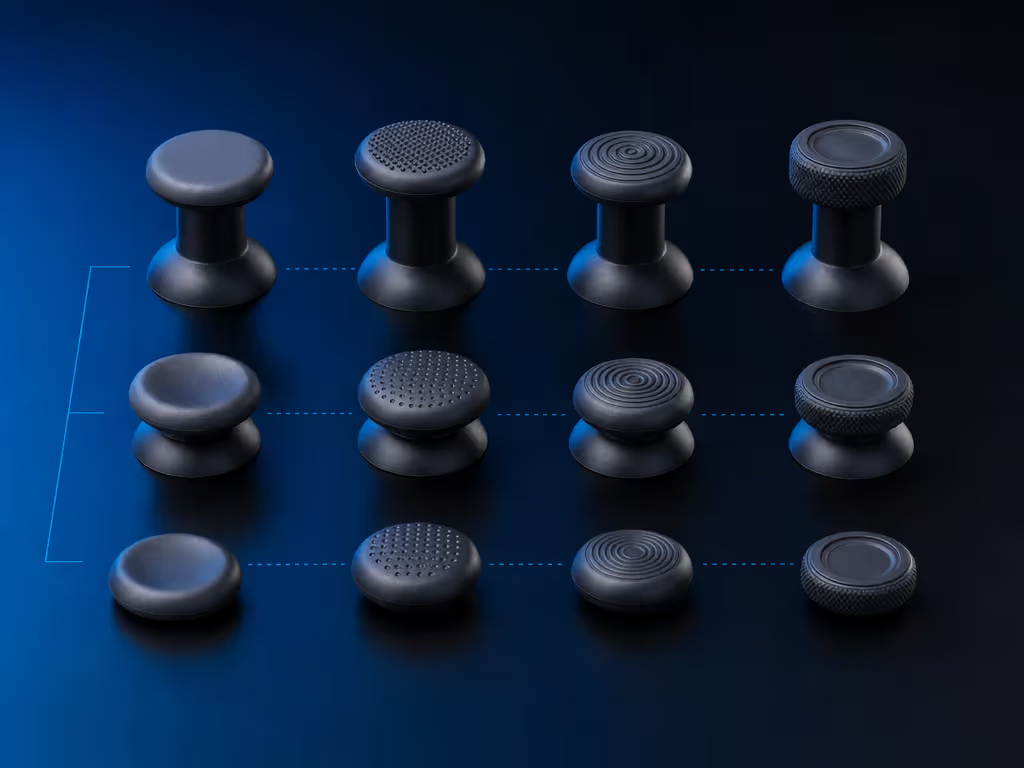
In this guide, Performance Thumbsticks refers to KontrolFreek's add-ons, which the company describes as snapping on and off a controller's original thumbsticks. KontrolFreek's catalog sorts its products by height (high, low, mid, or mixed) and top style, such as concave, convex, or hybrid.
Be careful with broad assumptions about installation. For example, KontrolFreek describes its Performance Thumbsticks as snapping on and off the original sticks; that does not mean every thumbstick grip accessory uses the same attachment method or fits every controller.
The practical appeal is modest but real: rather than committing to a new controller, you can test whether a different stick height or surface profile better matches your playstyle. That makes accessories a potentially lower-cost experiment, not a substitute for diagnosing a controller fault.
Fit-check before you buy
- Identify your exact controller model, not just its console family.
- Look at the stock-stick top: concave and domed sticks can have different fit requirements.
- Confirm the accessory maker's current compatibility guidance for that controller.
- Decide which stick you want to change: movement, camera/aim, or both.
- Give yourself permission to return to stock sticks if the new setup makes your hand tense.
FAQ: Are high-rise thumbsticks better for aim?
Not universally. KontrolFreek describes its high-rise thumbsticks as adding substantially more height and increasing the stick's range of motion, a design rationale that it says permits smaller aiming adjustments. That is a reason some FPS players may want to try one on the right stick; the collected evidence does not independently prove that a taller cap will improve every player's accuracy. For a broader look at how stick layout and trigger response vary by genre, see this guide to genre-optimized controllers.
The collected evidence includes no controlled, independent comparison showing that clip-on thumbstick add-ons improve aiming accuracy against stock sticks. Treat the change as a skill-and-fit variable. A setup that feels promising in the first ten minutes may feel awkward when you must repeatedly move between the stick, face buttons, and triggers.
KontrolFreek also says that its high-rise options can take a few sessions to get used to. That adjustment period matters. Do not raise sensitivity, change your dead zones, and add a tall cap all on the same evening, you will not know which change is helping or hurting.
A calm test protocol
- Keep your game settings unchanged for the first trial.
- Use the accessory in one familiar mode or training space for several short sessions.
- Notice overshooting, undershooting, and whether you are gripping harder to feel in control.
- Compare the result with your stock stick on another day.
- Keep the option only if it feels repeatable, not merely different.
Comfort is not a cosmetic bonus. A relaxed, repeatable hand position gives you more capacity to focus on the game.
FAQ: When do low-rise thumbsticks make more sense?
According to KontrolFreek's product guidance, low-rise thumbsticks add a smaller amount of height while keeping the feel closer to the original stick. The company says players may prefer them when they want familiarity, quick movements, and added grip or comfort without a dramatic height change. Those are manufacturer descriptions, so use them as a starting hypothesis rather than a promise.
Low-rise options are a sensible first experiment when you already like your controller's general geometry and do not want a large change. They may also make the comparison cleaner: if the new height is subtle, you can tell whether the altered top profile is welcome without simultaneously relearning a much taller stick.
For FPS games, KontrolFreek describes a mixed-height convention: low-rise on the left movement stick and high-rise on the right aiming stick. You do not need to follow that pattern. If the taller right stick makes you brace your hand, tense your thumb, or lose confidence in quick camera turns, it is not automatically the right configuration for you.
FAQ: Does concave, convex, or hybrid shape matter?
It can matter to preference, but no single shape has earned a universal verdict. Concave, convex, and hybrid describe the top profile where your thumb rests. Some players like a pocketed surface; others prefer a rounded one. In a dated single-reviewer comparison, the reviewer characterized thumbstick-grip preference as individual and described one hard-plastic grip as uncomfortable (useful as a reminder that personal fit varies, not as a performance test).
The collected evidence does not isolate concave, convex, and hybrid effects on comfort or performance across a representative group of players. So skip claims that one profile is objectively best for every genre, hand size, or aim style.
Fit-check while you play
- Your thumb should settle on the top without constant repositioning.
- Your grip should remain light enough that your palm and forearm are not bracing unnecessarily.
- Reaching face buttons or triggers should not make you twist into an uncomfortable position.
- A few missed inputs while adapting are information, not a reason to squeeze harder.
- If one stick feels good and the other does not, use a mixed setup or go back to stock on one side.
FAQ: Are thumbstick grips worth it?
They can be worth trying when you have a specific, testable goal: you want a modest change from the stock height, a different top profile, or a removable way to explore fit. They are less compelling if you expect them to resolve drift, phantom inputs, disconnections, or another controller problem. The collected information only establishes that certain add-ons attach to original thumbsticks; it does not establish repair outcomes for controller faults.
Value also depends on compatibility. As of September 17, 2026, KontrolFreek's controller-specific compatibility guide stated that its Performance Thumbsticks were primarily designed for standard PlayStation 5, PlayStation 4, Xbox Series X|S, and Xbox One controllers. Because compatibility information can change, check the current guide before purchase. The guide retrieved on that date also stated that the company's low-rise Xbox Series X|S/One products fit the concave stock sticks on Xbox Elite and Elite Series 2 controllers, but not their domed stock sticks. That guidance is specific to that product line and those stock-stick shapes, so verify both against the current guide before ordering.
A good buying question is not "Will this make me better?" It is "What exactly am I trying to change, and can I test it without forcing my hand to adapt to discomfort?"
FAQ: Can thumbstick grips damage a controller or prevent pain?
The collected official safety documentation does not establish whether thumbstick grips cause damage, residue, sticking problems, or drift. Follow the accessory maker's compatibility information and check the condition of the controller's original sticks as you use it. Beyond that, do not treat confident online anecdotes as a safety guarantee.
Likewise, the collected evidence includes no controlled, independent testing that compares clip-on add-ons with stock sticks for comfort, fatigue, or injury risk. For the biomechanics behind grip position and hand strain, explore this guide to controller ergonomics and hand biomechanics. Do not treat a grip as medical treatment or frame it as protection against pain.
Please take discomfort seriously. Gaming-related hand and wrist concerns are associated in broader guidance with repetitive rapid hand motion and prolonged poor posture. Build in regular breaks (one clinical-practice source suggests brief breaks about every hour) and keep your overall setup as relaxed as you can. If it hurts, it's costing you frames and fun. Persistent or concerning hand, wrist, or elbow symptoms deserve evaluation from a qualified health professional.
Further exploration: make the smallest useful change
Start with the problem you can actually describe: a stock stick that feels too shallow, a top shape that will not stay comfortably under your thumb, or a desire to test a manufacturer-described high-rise aiming setup. Change one variable, play a familiar game, and listen to the feedback from both your performance and your hands.
A performance accessory earns its place when it makes control feel more sustainable for you, not when it asks you to ignore strain in pursuit of a theoretical edge.
Related Articles